Introduction
If you’ve ever bitten into a sun-ripened tomato straight from the garden, you know the difference: taste, texture, vibrancy—all dialed up. Compare that to a pale, mass-produced grocery store tomato that tastes like existential dread. Same species, wildly different experience.
Now apply that logic to magic mushrooms.
While most people focus on psilocybin content, what’s often overlooked is how the mushroom was grown. And much like wine, coffee, or cannabis, the environment in which mushrooms grow—especially the substrate (aka their food)—can significantly affect the quality of your experience.
1. What Is a Substrate, and Why Should You Care?
A substrate is the material mushrooms grow on. It’s their soil, their dinner plate, their foundational vibe. Commercial growers often use sterile, uniform mixes designed for yield and efficiency: think brown rice flour or vermiculite. These work fine for volume—but do they nourish the mushroom?
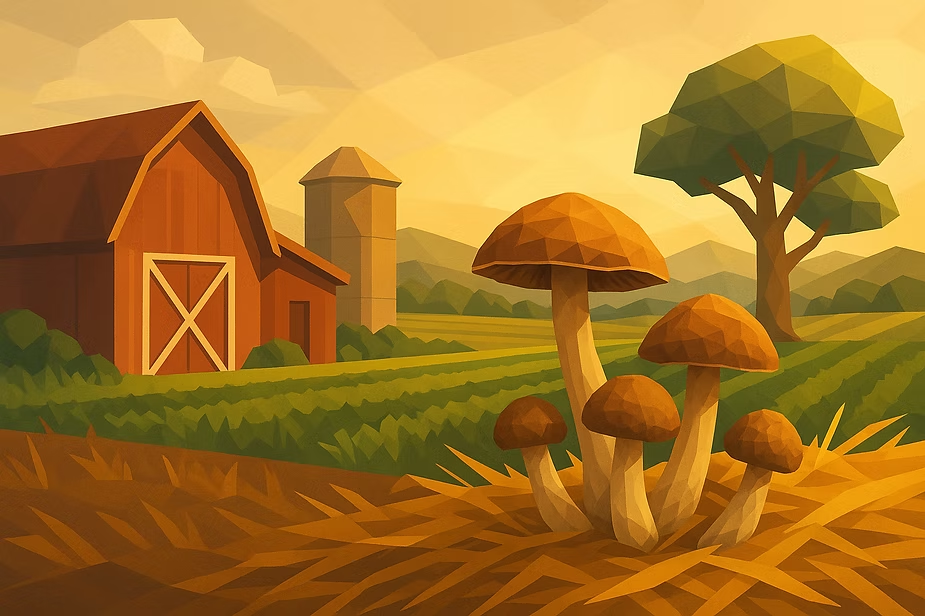
At Mammoth Mushrooms, we use a rich, living substrate composed of goat manure, straw, and other farm-sourced organic materials. It smells like the countryside and works like magic (literally).
Why? Because mushrooms are nature’s recyclers. They thrive on complexity. A richer substrate means a richer profile of tryptamines, alkaloids, and potentially other synergistic compounds that shape the experience—in both body and mind.
2. It’s Not Just About Potency
We get it: everyone loves a number. But chasing high psilocybin percentages is like choosing wine based solely on alcohol content. You miss the nuance.
From our own testing, we’ve seen Penis Envy mushrooms top out around 2% tryptamine content, while typical cubensis strains like Hillbilly or Mexicana hover around 0.6–0.8%. But ask our regulars, and they’ll tell you: it’s not just how much psilocybin, it’s how it feels.
A mushroom grown in living, nutrient-rich substrate tends to feel more “rounded,” more connected, and less chemically sharp. It’s hard to quantify, but easy to feel—especially when microdosing regularly (see: Week 3 – The Basics of Microdosing).
3. The Energetics of Growth: Intention, Music, and Vibe
Substrate is just the start. We grow our mushrooms to the rhythm of Pink Floyd vinyls spinning in the background (no, really). It’s not a gimmick—studies show that sound waves influence plant and fungal growth, impacting everything from yield to morphology.
There’s growing evidence that intention and environmental energy during cultivation play a role in the final product’s effect. It’s a bit woo-woo, but not out of line with what organic farmers, herbalists, and Indigenous plant workers have known for centuries: the growing process shapes the medicine.
4. Mass Production vs. Integrity-Driven Cultivation
Many commercial mushrooms are grown with speed and scale in mind. Fast flushes, sterile rooms, pre-packaged substrate blocks—it works, but it’s a factory farm vibe. Nothing wrong with it per se, but it lacks the vitality of a handcrafted, soil-based approach.
When you choose mushrooms grown in a nutrient-dense, biodiverse environment, you’re not just getting a product. You’re getting a story—one rooted in regenerative practices, slow cycles, and respect for the organism.
It’s the difference between fast food and slow food. Between canned beats and a live set.
Conclusion: Grow Rich, Journey Deep
When you choose magic mushrooms, you’re choosing more than a molecule. You’re choosing an experience—and that experience begins long before you consume it.
At Mammoth Mushrooms, we’re committed to growing with integrity: nutrient-rich substrate, intentional energy, and practices that honor the fungi as more than just a delivery system for psilocybin.
The next time you feel the effects of your favorite strain, remember: it didn’t start in your brain. It started in the soil.
Introduction
Imagine your brain as a busy airport. Planes take off and land on schedule, the same routes running over and over with mechanical precision. Efficient? Yes. Flexible? Not so much.
Now imagine grounding the air traffic for a while. Suddenly, you have space. Stillness. New paths to explore.
That’s kind of what psilocybin does to your brain’s Default Mode Network (DMN)—a key system responsible for self-reflection, future-planning, and the ever-present voice in your head that likes to narrate your life. When you’re stuck in loops of overthinking, anxiety, or rumination, the DMN is often the culprit. And psilocybin, at the right dose, appears to gently turn down the volume.
1. What is the Default Mode Network (DMN)?
The DMN is a network of interconnected brain regions that light up when you’re not actively focused on a task—like when you’re daydreaming, worrying about the future, or replaying a conversation from five years ago.
In healthy doses, this system helps you maintain a stable sense of self. But when it becomes overactive, it can trap you in repetitive thought patterns, feeding anxiety, depression, and self-judgment.
2. How Psilocybin Interrupts the Loop
Research from institutions like Johns Hopkins and Imperial College London shows that psilocybin temporarily disrupts the DMN, quieting the ego-driven narrator and allowing other brain regions to communicate in new ways.
In fMRI scans, this looks like a quieted DMN and a web of unexpected connections lighting up across the brain—a phenomenon known as increased neural entropy. It’s like your brain switches from a rigid highway system to a vast, exploratory trail map.
This disruption is often what leads people to report feelings of ego-dissolution, expanded perspective, and interconnectedness. You step out of the echo chamber and into a more spacious mind.
3. Why This Matters for Healing
Many forms of mental suffering—especially depression and anxiety—are associated with a hyperactive DMN. By temporarily stepping outside of this loop, psilocybin gives the brain a chance to reset.
It’s no coincidence that many users describe the days and weeks after a mushroom experience as “quiet” or “clear.”
For a deeper dive into how microdosing taps into this potential with less intensity, check out Week 7 – Microdosing for Awareness and Mindfulness.
4. Long-Term Change Comes From Integration
Here’s the twist: disrupting the DMN is just the beginning. Real healing comes from what you do after the trip. That moment of clarity? It’s an invitation to change your story, your habits, your patterns.
This is where journaling, therapy, mindfulness, or community reflection can take the experience from momentary to meaningful. The brain has new trails open—but you still have to walk them.
Conclusion: Turning Down the Noise to Hear Yourself Again
Psilocybin isn’t about turning you into someone new. It’s about giving you space from the mental loops that keep you from being who you already are.
By quieting the Default Mode Network, even temporarily, mushrooms offer a taste of a quieter mind—a reset button for the soul. Whether through a full journey or a gentle microdose, it’s a chance to step off the autopilot and remember: you’re not your thoughts. You’re the one who hears them.