Understanding Magic Mushroom Doses and Their Uses

If you’ve ever stood at the crossroads of decision-making in wellness, then the world of magic mushroom doses is your next stop. From the subtle whispers of a microdose to the cosmic shout of a megadose, each level offers a unique journey. But before you embark, let’s revisit some key insights from our past explorations.

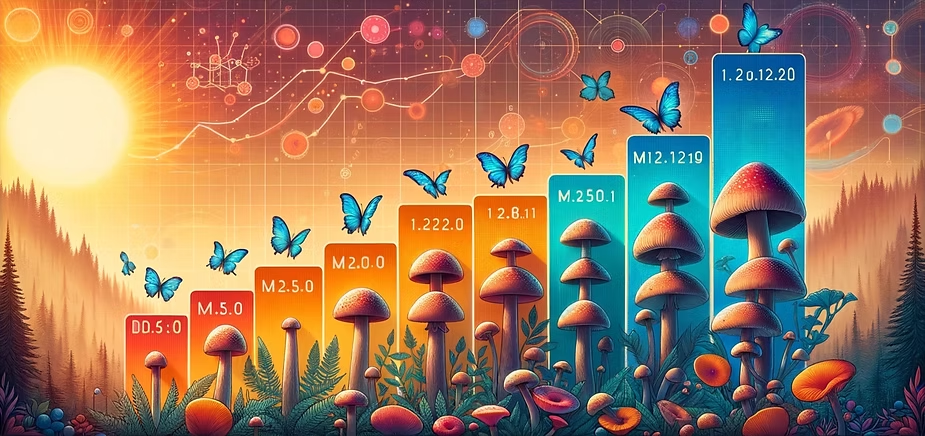
Microdose: A Gentle Introduction (0-0.5g) The microdose is your discreet companion in cognitive enhancement. It’s about fine-tuning your mental engine, a concept we delved into during the Basics of Microdosing: A Beginner’s Guide. Perfect for those seeking a slight edge in creativity and focus, it’s the first step in a larger journey of self-discovery.

Mini Dose: The Social Spark (0.5-2g)

Stepping up, the mini dose is where the colors get a little brighter and the conversations a bit deeper. It’s akin to the social fluidity we often seek from alcohol, but without the hangover, as discussed in Microdosing vs. Alcohol: A Healthier Alternative?. It’s for those moments when you want to connect more profoundly, be it with nature, art, or the people around you.

Macro Dose: The Explorer’s Gateway (2-3.5g) The macro dose is where things start to shift from the external world to the vast universe within. This dose is about introspection and exploration, a theme we touched upon when discussing the transition into a new year in Welcoming the New Year with Microdosing. It’s for those ready to dive deeper into their consciousness.

Mega Dose: The Deep Dive (4+g) The mega dose is not for the faint of heart. It’s a journey to the core of your being, and beyond. It’s where the boundaries blur, and the ego dissolves, offering insights that can be life-changing. This level of experience requires preparation and respect, a topic we’ve emphasized when talking about maintaining cognitive health in Maintaining Cognitive Health over the Holidays.

Each of these doses offers a different perspective, a different depth of experience. At Mammoth Mushrooms, we provide the full spectrum, guiding you to make informed choices in your journey with psilocybin. Whether you’re starting small or going big, remember: the journey is as important as the destination.

Introduction

Imagine your brain as a busy airport. Planes take off and land on schedule, the same routes running over and over with mechanical precision. Efficient? Yes. Flexible? Not so much.

Now imagine grounding the air traffic for a while. Suddenly, you have space. Stillness. New paths to explore.

That’s kind of what psilocybin does to your brain’s Default Mode Network (DMN)—a key system responsible for self-reflection, future-planning, and the ever-present voice in your head that likes to narrate your life. When you’re stuck in loops of overthinking, anxiety, or rumination, the DMN is often the culprit. And psilocybin, at the right dose, appears to gently turn down the volume.


1. What is the Default Mode Network (DMN)?

The DMN is a network of interconnected brain regions that light up when you’re not actively focused on a task—like when you’re daydreaming, worrying about the future, or replaying a conversation from five years ago.

In healthy doses, this system helps you maintain a stable sense of self. But when it becomes overactive, it can trap you in repetitive thought patterns, feeding anxiety, depression, and self-judgment.

2. How Psilocybin Interrupts the Loop

Research from institutions like Johns Hopkins and Imperial College London shows that psilocybin temporarily disrupts the DMN, quieting the ego-driven narrator and allowing other brain regions to communicate in new ways.

In fMRI scans, this looks like a quieted DMN and a web of unexpected connections lighting up across the brain—a phenomenon known as increased neural entropy. It’s like your brain switches from a rigid highway system to a vast, exploratory trail map.

This disruption is often what leads people to report feelings of ego-dissolution, expanded perspective, and interconnectedness. You step out of the echo chamber and into a more spacious mind.

3. Why This Matters for Healing

Many forms of mental suffering—especially depression and anxiety—are associated with a hyperactive DMN. By temporarily stepping outside of this loop, psilocybin gives the brain a chance to reset.

It’s no coincidence that many users describe the days and weeks after a mushroom experience as “quiet” or “clear.”

For a deeper dive into how microdosing taps into this potential with less intensity, check out Week 7 – Microdosing for Awareness and Mindfulness.

4. Long-Term Change Comes From Integration

Here’s the twist: disrupting the DMN is just the beginning. Real healing comes from what you do after the trip. That moment of clarity? It’s an invitation to change your story, your habits, your patterns.

This is where journaling, therapy, mindfulness, or community reflection can take the experience from momentary to meaningful. The brain has new trails open—but you still have to walk them.

Conclusion: Turning Down the Noise to Hear Yourself Again

Psilocybin isn’t about turning you into someone new. It’s about giving you space from the mental loops that keep you from being who you already are.

By quieting the Default Mode Network, even temporarily, mushrooms offer a taste of a quieter mind—a reset button for the soul. Whether through a full journey or a gentle microdose, it’s a chance to step off the autopilot and remember: you’re not your thoughts. You’re the one who hears them.